
Ancient Egyptian Pleasure Boat Found by Archaeologists off Alexandria Coast
London, UK, December 8 2025
A Luxurious Link to History: Ancient Egyptian Pleasure Boat Found by Archaeologists off Alexandria Coast, Confirming Strabo’s Account
Headline Points:
• Underwater archaeologists discover a rare, well-preserved Ancient Egyptian Pleasure Boat off the submerged coast of Alexandria.
• The 35-metre long vessel, dating to the first century AD, perfectly matches a description by the Greek historian Strabo.
• The boat, designed for elite leisure and possibly religious processions, was found near the sunken Temple of Isis.
• The discovery, a first of its kind, provides new insight into the luxurious lifestyle and religious practices of early Roman Egypt.
• Research continues on the site, with Greek graffiti on the ship’s timbers yet to be fully deciphered.
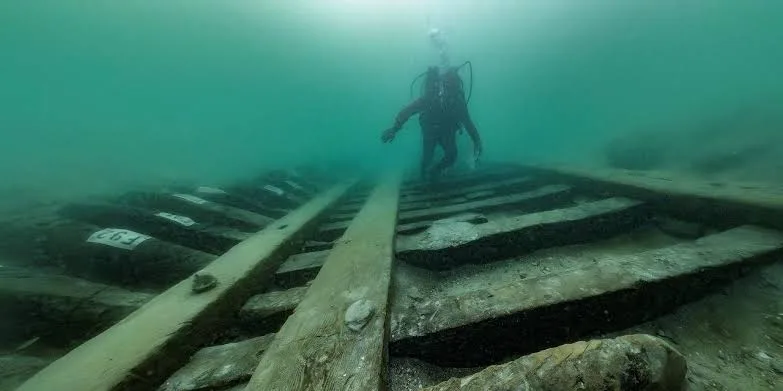
The waters off the coast of Alexandria, Egypt, have once again yielded a treasure of immense historical significance, with underwater archaeologists announcing the discovery of a remarkably preserved Ancient Egyptian Pleasure Boat Found by Archaeologists off Alexandria Coast.
This unique discovery provides a spectacular, tangible link to the luxurious lifestyle of the Greco-Egyptian elite during the Roman period.
Measuring an impressive 35 metres long and approximately 7 metres wide, the vessel’s large central pavilion and flat-bottomed design confirm its intended use for leisure excursions along the shallow canals and lagoons of the ancient city’s great port.
This specific type of highly decorated pleasure boat was only known through the writings of classical historians, making the find a major moment in maritime archaeology.
What makes this particular discovery so compelling is the direct connection it establishes with ancient eyewitness accounts.
The vessel’s features align precisely with the detailed descriptions of such boats written by the first-century Greek geographer and historian, Strabo, who visited Alexandria between 29 and 25 BC.
Strabo described these craft as being “luxuriously fitted out and used by the royal court for excursions,” noting the “crowd of revellers” who used them for public festivals, complete with music and dancing.
The excavation, led by the European Institute for Underwater Archaeology (IEASM) under Dr. Franck Goddio, thus transforms a historical text into a three-dimensional reality, offering an unprecedented window into the high-society culture of the era.
The pleasure boat was found just 7 metres below the surface, lying under 1.5 metres of sediment near the submerged island of Antirhodos, a former part of ancient Alexandria’s Portus Magnus (Great Harbour).
It lay less than 50 metres from the ruins of the Temple of Isis, a factor that has led researchers to speculate about the boat’s possible religious function.
Archaeologists theorize that the vessel may have been a Navigium, a richly decorated boat used in the annual navigium Isidis procession, a major religious festival celebrating the goddess Isis, mistress of the sea.
Its sinking, possibly during the catastrophic earthquakes and tidal waves around AD 50 that caused parts of the royal quarter to subside beneath the sea, ensured its preservation.
The sheer scale of the 35-metre long Ancient Egyptian Pleasure Boat suggests it would have required a large crew of up to twenty rowers, allowing it to move its high-ranking passengers in opulent comfort.
Research on the site is ongoing, with investigators working to decipher Greek graffiti found on the central carling of the ship’s timbers—a text that promises to reveal further details about the boat’s history and its passengers.
Per UNESCO guidelines, the vessel itself will likely remain on the seabed for long-term conservation, with surrounding excavations expected to yield further evidence of elite life, trade, and religious practice in the cosmopolitan heart of early Roman Egypt.
The discovery is hailed by Egypt’s Ministry of Tourism and Antiquities as powerful evidence of Alexandria’s continuing importance as a cultural and historical epicentre.

